
Mold Remediation
Containment, HEPA filtration, and antimicrobial treatment eliminate mold colonies at the source and prevent cross-contamination throughout the property.
Learn More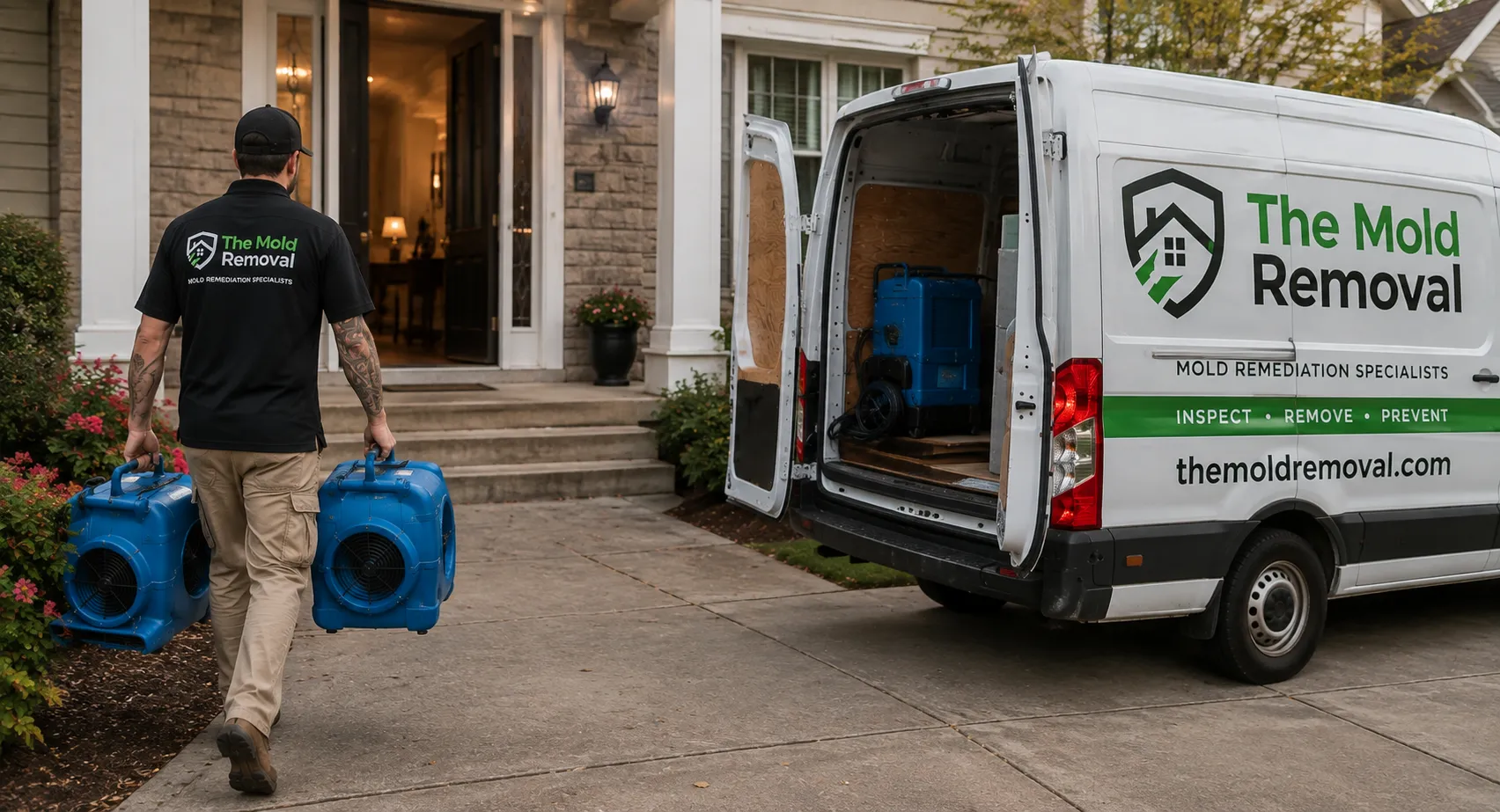
Alabama · Florida · Louisiana · Mississippi · South Carolina · See All Locations
The Mold Removal
At your door, on your schedule - independent mold professionals, nationwide
24/7/365 live response from local crews · Local pros often target a 60-minute response
Choose your state or browse the most in-demand cities for mold removal and water damage services.
One number reaches independent mold specialists who work their own region, in every state.
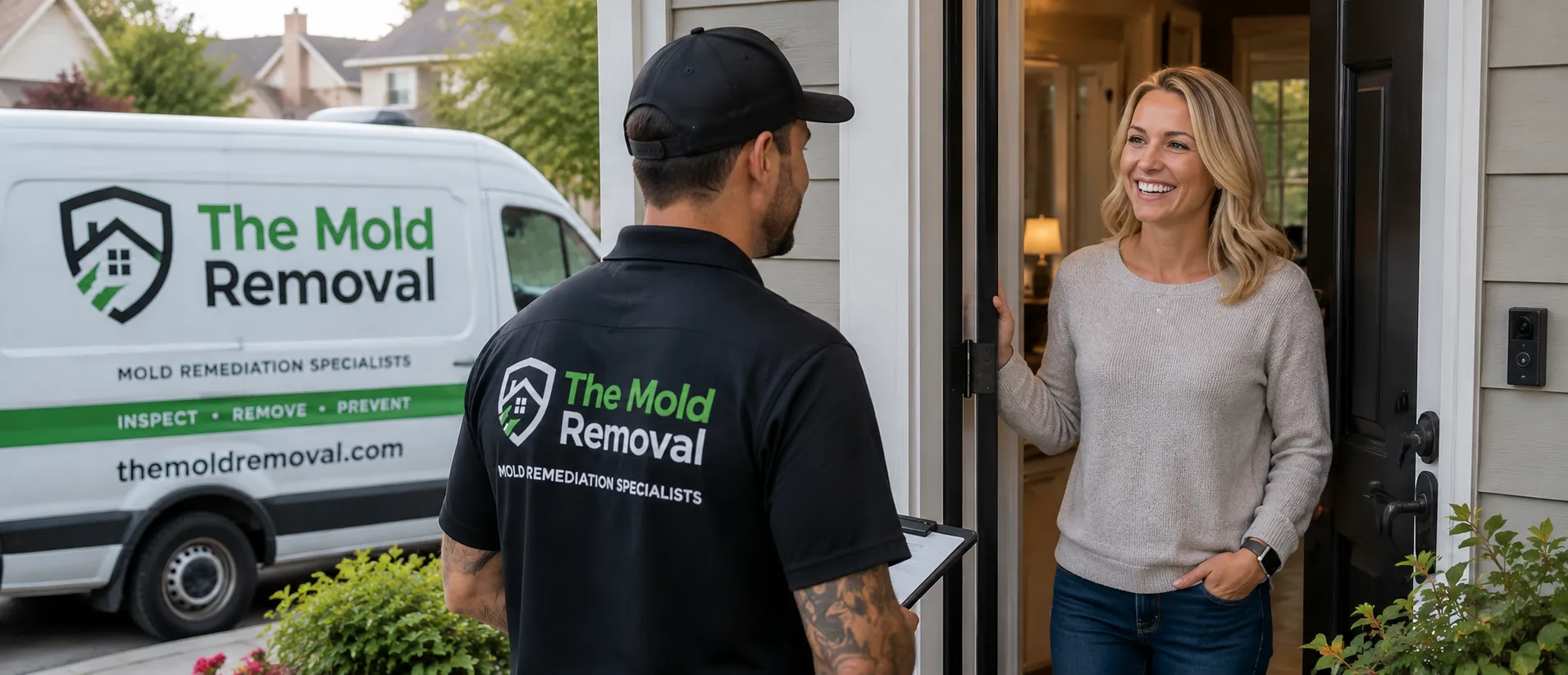
Each stage is performed by the independent remediation contractor the call reaches, following industry standards.
01
An assessor identifies the presence of mold, determines how far the growth extends, and locates the source of moisture.
02
Protective barriers and negative air pressure are established to prevent spores from spreading into unaffected areas.
03
Porous materials that cannot be safely cleaned are removed — including drywall past the moisture line, insulation, carpet pad, and damaged cabinet bases.
04
Commercial dehumidifiers and air movers return the structure to a dry standard, with moisture readings taken from the material itself rather than the surface.
05
The assessor who wrote the protocol returns to confirm the remediation succeeded and that the moisture source has been fully resolved.
Residential and commercial work, available through local pros in every city listed below.
Containment, HEPA filtration, and antimicrobial treatment eliminate mold colonies at the source and prevent cross-contamination throughout the property.
Learn MoreAn assessor determines whether mold is present, identifies where it is growing, and measures how far it has spread — before any remediation quote is issued.
Learn MoreCategory 3 black-water losses are handled with full PPE, biohazard disposal, and professional disinfection to restore safe conditions.
Learn MoreChoose your state or browse the most in-demand cities for mold removal and water damage services.
No popular city matches that search — the state grid above covers everywhere else.
Not seeing your state? Coverage is not limited to the cities with their own pages — those exist because the local rules there are worth writing down. Call and you will be routed to the nearest independent contractor either way.
Urgent water and mold situations are answered around the clock, with professionals available depending on local coverage and demand.
No long forms or multiple callbacks. One number connects you with an independent professional who serves your area.
Specialists who work their own region, familiar with its standards, permitting requirements, and safety protocols.
Service options across all 50 states, with local professionals who understand the specific rules and conditions that apply in each region.
Describe what you're seeing, and a professional can advise you on the next steps and determine whether an assessment is needed.
Quoted by the pro who visits — not by us.
Describe what you are seeing and you will be connected with an independent pro covering your area. There is no form to fill in and no callback queue.
(833) 243-4415Pricing depends on the size of the affected area, the type of material involved, and how far moisture has traveled. Small, surface-level jobs may cost a few hundred dollars, while structural remediation can run higher. The professional who visits can provide an on-site quote after assessing the damage.
Sensitivity to indoor mold varies from person to person, and some people are affected more than others. An assessor can identify the type present and recommend the safest remediation approach. Questions about your own health belong with a clinician rather than a remediation contractor.
In most cases, yes. An inspection determines where the mold is growing, how far it has spread, and what caused the moisture. This prevents incomplete removal and ensures the remediation plan matches the actual conditions.
Response times vary by location, technician availability, and demand. Many areas offer same-day or next-day service when coverage allows. Calling is the fastest way to check availability in your city.
Service options are available across all 50 states, with coverage depending on local provider participation. When you call, your city is used to route you to an independent professional who serves that region.
Bleach may lighten stains on non-porous surfaces, but it does not eliminate mold roots inside drywall, wood, or insulation. Professional remediation uses HEPA filtration, containment, and antimicrobial treatment to remove mold at the source.
Most homeowners stay in the property during the work. Containment barriers and negative air pressure isolate the affected area so the rest of the home remains usable. Larger projects may require temporary relocation depending on the scope.
Remediation professionals use containment, floor protection, and dust-control measures to safeguard unaffected areas. Items inside the work zone may be moved, covered, or cleaned depending on the remediation plan.
Mold removal refers to physically taking out contaminated material. Mold remediation includes removal plus containment, HEPA filtration, drying, and antimicrobial treatment to prevent regrowth and cross-contamination.
When moisture is eliminated and the affected materials are properly treated or replaced, mold should not return. The professional who visits should identify the moisture source so the issue can be resolved long-term.
An inspection identifies where mold is growing, how far it has spread, and what caused the moisture. Remediation removes affected materials, dries the structure, and treats the area to prevent regrowth. Some states require inspection and remediation to be performed by different licensed professionals to avoid conflicts of interest.
Not all mold is harmful. Testing helps determine whether the mold is allergenic, toxic, or simply cosmetic. Removal is recommended when mold affects structural materials, spreads beyond a small area, or is linked to moisture problems.
The professional who visits should walk you through the findings, outline the remediation steps, and provide a clear estimate. A written assessment or report is often used to guide the remediation plan.
Mold grows when moisture is present. Common causes include leaks, humidity, condensation, and poor ventilation. Fixing the moisture source is essential to prevent mold from returning.
Mold is a fungus that spreads through airborne spores. It grows on damp materials such as drywall, wood, and insulation. Left untreated it can damage building materials, and sensitivity to indoor mold varies between people.
Category 1 ('clean' water): Water from a clean source such as a supply line or faucet. Category 2 ('gray' water): Water with moderate contamination, such as appliance discharge or toilet overflow without feces. Category 3 ('black' water): Highly contaminated water such as sewage or floodwater, requiring specialized handling.
Testing may include air sampling or surface sampling to determine mold presence and type. Only qualified professionals should perform testing, especially when mold may be inside walls or structural materials.
Small, surface-level mold—such as on a bathroom ceiling—can often be cleaned and repainted. Larger areas, recurring growth, or mold linked to leaks should be handled by licensed professionals.
'Black mold' refers to the appearance of certain molds, not a scientific classification. The species most associated with black mold is Stachybotrys chartarum, which grows on damp materials with high cellulose content.
Remediation includes removing affected materials, drying the structure, treating surfaces, and addressing the moisture source. Remediation professionals use containment, HEPA filtration, and antimicrobial treatment to prevent cross-contamination.
Enough to know what you are looking at, what testing will and will not tell you, and when the answer is a contractor rather than a bucket.
Spores are already in every building, all the time - they arrive on shoes, on clothes, through open doors. What decides whether they grow is moisture, a food source, and time. The food source is the building itself: paper facing on drywall, wood, dust in ductwork. The spores cannot be removed from indoor air permanently, and the EPA says as much. That leaves moisture as the only variable anyone controls, which is why every serious remediation starts by finding the water rather than by scrubbing the wall.
Visible growth on a surface is the obvious case. Less obvious: a musty smell with nothing visible, which usually means growth inside a wall cavity, under flooring, or above a ceiling. Staining that returns after painting is another. Warping, bubbling paint, and drywall that feels soft to the knuckle all indicate moisture behind the surface, and moisture that has been there long enough to soften gypsum has usually been there long enough to grow something.
The phrase usually refers to Stachybotrys chartarum, one of many species that appear dark. Plenty of harmless-looking growth is the same species and plenty of dark growth is not. The EPA position is that sampling to identify species is rarely necessary for deciding what to do, because the response does not change with the answer: find the moisture, fix it, remove the growth, verify it is gone. Anyone quoting a higher price because of the color is charging for the word.
An assessment is mostly a moisture investigation. Meters, thermal imaging and sometimes cavity inspection locate where water is and where it came from. Air or surface sampling can confirm growth and give a spore count relative to outdoors, which is useful for confirming a space is clear after work. What sampling cannot do is tell you whether a particular building is affecting a particular person - that is not what the test measures, and no laboratory report answers it.
Containment first, so disturbing material does not move spores into clean rooms - plastic barriers, and negative air pressure vented outside. Then removal of porous material that cannot be cleaned: drywall cut back past the moisture line, insulation, carpet pad, cabinet bases. Non-porous surfaces are cleaned rather than removed. HEPA filtration runs throughout. Then drying, then verification. The rebuild is a separate job, and often a separate contractor.
Small, surface-level growth on non-porous material - a bathroom ceiling, tile grout, a window sill - is usually a cleaning job. Most states set a size threshold above which licensed work is required, commonly around 25 contiguous square feet, and the city pages on this site carry the figure that applies locally. Two things argue for calling regardless of size: growth that returns after cleaning, and growth you found by smell rather than by sight, because both mean the source is somewhere you have not looked.
Why the first day matters more than the next ten, what the categories mean when a contractor uses them, and what drying actually is.
The industry standard used by most restoration contractors, IICRC S500, sorts water by how contaminated it is. Category 1 is clean water from a sanitary source - a supply line, a water heater. Category 2 is significantly contaminated: washing machine overflow, dishwasher discharge, toilet overflow without solids. Category 3 is grossly contaminated: sewage, rising groundwater, river or sea water. The category drives what can be dried and kept versus what has to be removed and thrown away, so it is worth asking which one a contractor is scoping to.
Clean water does not stay clean. Sitting in contact with building materials, at room temperature, Category 1 water migrates toward Category 2 and then Category 3 as material breaks down and organisms multiply. Time and temperature drive it. This is the practical reason a burst pipe found on day three is a materially different job from the same pipe found in the first hour, and why a quote given over the phone before anyone has seen the water is guesswork.
Air movers do not dry anything by themselves. They break the saturated boundary layer sitting against wet surfaces so moisture can evaporate into the room air; the dehumidifier then removes it. That is the whole cycle, and it is why opening windows in a humid climate makes things worse - you are adding moisture faster than it leaves. Proper drying is a closed system with logged readings, and the readings come from inside the material, not from touching the surface.
The EPA advises drying wet materials within 24 to 48 hours to prevent mold growth. That window is why emergency response exists as a category of work at all. Miss it and the job changes: what would have been extraction and drying becomes containment, removal, and disposal, at a different cost and on a longer timeline. Everything else about water damage response follows from trying to stay inside those two days.
Non-porous material - tile, glass, sealed concrete, metal - can almost always be cleaned and kept. Semi-porous material like structural wood and unsealed concrete usually dries in place. Porous material - drywall, insulation, carpet pad, particle board, upholstery - depends on category and duration: Category 1 caught early is often salvageable, Category 3 essentially never is. A contractor who wants to remove everything regardless of category, or keep everything regardless, is worth a second opinion.
What actually drives a price, what a standard policy typically does and does not cover, and the documentation that decides claims.
Affected area and the number of rooms. Category of water, because it decides how much material leaves the building. Whether cavities, subfloor or the slab are involved, since accessing those is labor. How long equipment has to run, which is a function of climate and construction. Whether containment is required. Whether the rebuild is included or quoted separately. Any national average you read is the mean of jobs that share none of these variables with yours, which is why nobody serious quotes before seeing it.
Most homeowners policies in the United States turn on this distinction. A pipe that bursts is generally a covered peril; the same pipe seeping unnoticed for eight months generally is not, on the grounds that it counts as maintenance. Mold coverage is frequently capped or excluded outright, and where it is covered it is often only as a consequence of a covered water event. Flooding from outside is normally not covered by a homeowners policy at all and requires separate flood insurance.
Photographs before anything is moved. Moisture readings at the start and logged daily. A written scope saying what is being removed and why. Equipment counts and run times. Photographs of hidden damage as it is exposed. Adjusters are reconciling a claim against a standard, and the contractors who get claims paid without argument are the ones whose paperwork already answers the questions the adjuster is going to ask. Ask to be copied on all of it, at the time, not at the end.
Two numbers for the same house routinely differ by thousands, and it is almost never the same work priced differently - it is different work. Ask each contractor to state the water category they are scoping to, exactly what material they are removing, whether containment is included, whether drying is monitored and logged, whether verification after the work is included, and whether the rebuild is in or out. Once those six answers line up, the numbers become comparable, and usually much closer.
How licensing and certification actually work in this trade, what to ask, and the signals worth walking away from.
There is no national contractor license for this work. Some states license mold assessment and remediation specifically - Texas, Florida, New York and Louisiana among them - and several of those keep assessment and remediation as separate credentials that one company may not hold on the same job. Other states have no mold-specific licensing at all and the work falls under general contracting rules. State licensing bodies publish public license lookups; the city pages here carry the rule that applies locally with its citation.
IICRC certification is the common industry credential and it is genuinely meaningful - it indicates training against the published standards, S500 for water damage and S520 for mold remediation. It is not a government license and does not substitute for one where a state requires it. A firm can be certified and unlicensed, or licensed and uncertified. Ask which of the two you are being shown, because contractors sometimes use the words interchangeably in marketing.
What license do you hold for this work in this state, and what is the number. Are you certified, and to which standard. Do you carry general liability, and does it cover mold work specifically, since some policies exclude it. Will you provide a written scope before starting. Who does the verification after remediation. Is the rebuild included. None of this is adversarial and any established firm answers it in a couple of minutes.
A price quoted before anyone has seen the property. Pressure to sign on the first visit. A company offering to both assess and remediate in a state that separates those roles. Refusal to put the scope in writing. Claims that a particular species requires special pricing. And any pitch built on what mold might be doing to the people in the house - that is a matter for a clinician, and a contractor raising it is selling with a fear they are not qualified to speak to.